

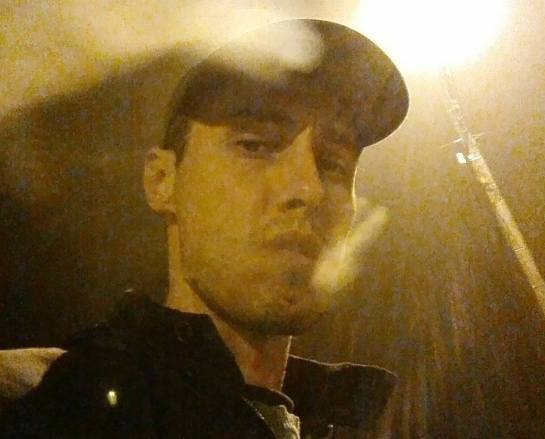
Photo by Jesse Ray Guillory
New Orleans’ Balasa, the joint project of Zayn Shaikh and Ashe Kilbourne, has been fomenting since July 2015, but it wasn’t until September 2016’s Teri Duniya single that we became fully aware of its power and potential. “Difference is intrinsic to the project,” says Shaikh, pointing to one of the project’s overarching concerns and an element that’s both apparent from the point of introduction and vital upon closer examination. Musically, Balasa works with extremity and contrast — Teri Duniya is a collision of Sufi music and bubblin’, the Dutch style comprised of sped-up dancehall constructions and edits — and in a short email conversation, Zayn and Ashe discussed the complex arrangement of a white and brown artist working in tandem, filial reconciliation and making music in and in response to a post-9/11 America. Collisions of noise and culture make up the backbone of each of Balasa’s three tracks to date and the internal struggle between the artists is apparent throughout as Kilbourne’s hardcore impulses (a jumpstyle version oif “Teri Duniya” almost came into being) either manifest or are rejected by Shaikh.
Fans of the KUNQ collective will likely be familiar with Kilbourne’s work and on New Years, the duo debuted at the New York crew’s party. 2016 also saw the release of Kilbourne’s Sourland, a brilliant take on hardstyle that brought a genuine enthusiasm to the form and showed off an aesthetic built on raw noise and dramatic flair. Shaikh’s solo efforts come under the Besharam, where they have delved into the “intersections of islamophobia in mainstream LGBTQ movements” and collided a range of contemporary club music in several clutter-heavy mixes. Both projects tend to deal with themes of dislocation at length, but Shaikh points to reconciliation as a major component of Balasa, pointing out that every Balasa track “has a strong connection to my childhood or my relationship to my parents.” It’s these sorts of conflicts and contradictions that Shaikh and Kilbourne seem to be dealing with both discursively and musically and it’s an attitude found throughout their Astral Plane mix, which was given the title ‘Glacial Reign’. We had a quick email chat about the origins of the project, bubblin’ and the idea of difference. Hit the jump for the full conversation and a track list that jumps from Calvin Harris to The Body and Sheila Chandra.
Hi Ashe and Zayn, how are you? Where are you answering these questions from?
Z: Hi! We’re answering from our living room in NOLA, everything is kind of strewn about and it feels like an accurate representation of my brain at the moment.
A: I’m aderall’d out, but sleepy.
Introduce yourselves and the Balasa project. We’ve been pretty obsessed with both mixes of “Teri Duniya” obviously, but I’m not sure all of our readers will know the background of the project and your respective solo projects.
Z: I’m Zayn, my solo project is called Besharam (it means “shameless” in Hindi, but it’s also an insult used in Bengali households by angry mums). Both of these projects are about reconciliation for me, with my family and my seemingly #opposing identities. Every Balasa song has a strong connection to my childhood or my relationship to my parents (i.e. trying to make them proud while pursuing a path that many people in their community consider to be against the grain)/filial responsibility. Balasa began in July 2015, right after I moved here. I was sharing some Ghazals and Sufi music with Ashe and we came across the Nooran Sisters and were immediately drawn to a song called “Ae Khuda Teri Duniya De”. We’d been toying with the idea of creating music together, but until then we didn’t really have a starting point. There were many, many drafts—including a really terrible jumpstyle version.
A: Which was my fault. I’m Ashe, my solo project is called Kilbourne, and hardcore is my life. Zayn and I share music with each other and talk about it so much it just makes sense to work together. That said, it takes a lot of communication for Balasa to function. Collaborating as a white person with Zayn who is brown is super loaded, especially when Balasa operates in a scene that I’ve been participating in for longer (even though we were both making punk/noise stuff before any of this). As a white person there is so much social capital to gain through being associated with artists of color, and rarely in music do white artists and audiences allow for an equal exchange of power.








 The Astral Plane