We were in an excitable mood while recording this week’s Astral Plane Radio and decided to whip into some high speed techno // ghetto house // Bmore pretty quickly. Shouts to Riley Lake, Hulo, Ase Manual, Chants and Plata for providing key cuts and to the gods Drexciya as always. It’s our insular opinion that this series has gotten better and better over time and we hope you’ve enjoyed the process as much as we have. Astral Plane Radio archives can be found here.
Mixes
Santa Muerte Mix For The Astral Plane
From an outsider perspective, Texas might appear to be a relative backwater in the dance music world, or, at best, a node for its worse proclivities, but that appearance is misguiding and the state has produced some of the most exciting artists, labels and nascent aesthetics in recent years. And that’s ignoring the state’s multitudinous contributions to hip hop dance, from Houston/Port Arthur’s long running dominance to Dorrough, Lil Twist and DJ Chose out of Dallas. Labels like #FEELINGS and Freshmore have championed self-referential hybrid forms while Austin has grown into a hub for young producers looking to find a sound, a way and a community. Among all of the youthful energy coming out of Austin and Houston, it would be easy to imagine the Texan avant-garde springing up out of the dust in the past several years, but that would overlook the influence of some of the scene’s elder statesmen. It can’t be stressed more that for every Rabit, Lotic or Mike G hailing from or reping Texas, there was an influencer, either direct or subliminal, who was there to breach grime, ballroom, etc., or even to match those styles with dembow or reggaeton.
And as far as Houston goes, it’s hard to look beyond the influence of Sines and his Freshmore imprint, a veritable institution that has been pushing diasporic bass sounds for the better part of the last four years. Recently, Sines joined up with fellow producer Panchitron, the Los Angeles-born producer who now resides in Houston, to form Santa Muerte. Focused on the intersectionality of contemporary dance music sub-culture, the duo has turned their focus on everything from instrumental grime abstractions to the wonderfully tinny direction that reggaeton has taken in the past decade. The name puts a focus on death, more specifically an understanding of how death is understood by the living, and the Santa Muerte sound is undeniably dark, a sweltering trip through choral VSTs, ballroom abrasions and the memorable crunch of the dembow loop. That being said, Santa Muerte is a project firmly focused on the dancefloor and while the attitude might be focused more on sonic muck, their originals, edits and mixes do tend to be wildly effective in the hip shaking department.
As a study of American dance sub-culture, Santa Muerte has been wildly successful, avoiding the pitfalls of mindless appropriation, historical revision and general dishonesty. The avant-garde fringes of the dance music world can often position themselves in too serious of a light, or worse, too seriously ironic, but Santa Muerte appears to be a project focused on honestly and earnestly working through, matching up and blending the United States’ (and beyond) veritable treasure trove of regional genres, styles, sub-cultures and aesthetics.
Trends Mix For The Astral Plane
From afar, it’s often difficult to tell who’s really gaining traction in the UK. That is, not just blog hype, but real support from a wide variety of producers, MCs and radio hosts. We’re lucky to be able to utilize the Internet to “engage” with the history of garage, dubstep, grime, etc., but gauging the present is another story. When a producer, DJ, etc. is really bubbling though, it’s not something we’re going to miss and that’s exactly what we’ve seen with Oxford’s Trends, a producer whose club tracks have been supported by Spooky, Slimzee, Slackk and everyone in between, as well as MCs like Flirta D, Riko Dan and Manga.
Having produced grime and drum and bass for the better part of a decade, Trends has the pedigree to work with the aforementioned list of stars and his unremitting style is perfect for the rave. Firmly in the tradition of Youngstar and early Plastician (Plasticman at the time), Trends has boiled grime down to its most important constituent elements, allowing for visceral reactions from both MC and crowd. His aesthetic is undeniably rough and the “banger” tag isn’t unwelcome, making tracks like “Catchphrase” and his remix of TC4’s “La La La” difficult to imagine outside of the rave/pirate radio context. That’s not to say that Trends’ work is one dimensional though, just that he’s dug out and excelled in a niche. And if you’ve ever seen Trends play out or tuned in to one of his radio sets, his Astral Plane mix will come as no surprise, a head first leap into bars from Novelist, Manga and more, Trends’ direct-as-ever production techniques flashing all over its 30 minute run time. It could be argued that this mix isn’t for the faint of heart, but that’s a silly, hardboiled platitude and this mix is a perfect shot in the arm for anyone remotely curious about grime, soundsystem culture, the ardkore ‘nuum or, well, bars in general.
Sami Baha Mix For The Astral Plane
With a simple refrain (“he ballin’ like the mavericks”), Turkish producer Sami Baha became a tantalizing figure, an almost entirely unknown quanity on one hand, but an artist who had crosshatched an aesthetic into the muddy earth of club music with surprising ease. “BA VIRD V1” was an instantly recognizable hit, a cornucopia of infamous loon samples, 808 bells and start-stop, electro-paced percussion, but it also achieved a style, maximalism, that has been out of vogue for several years now. Like Young Thug’s flow, Baha’s aesthetic is one of overload, and like Thug’s elastic, structure-crushing flow, there’s more than a little Lil Wayne alien DNA floating about. That unquantifiable DNA is what connects Baha’s productions to Glass Swords and not “mediocre trap hit 2013”, both a taste for chaos and a simple, undefinable sensibility. It’s what separates Visionist from the choral VST wielding masses and Evian Christ from the aforementioned trap masses. Sonic experimentation and a preference for grit and harsh sounds each play a part, but it also comes down to visual presentation and the simple avoidance of cringeworthy motifs. Regardless, Baha has developed an incredibly likable sound that touches on Atlanta rap, grime and kuduro, a clever combo that might end up overwrought in a less effective producer’s hands, but comes across effortless in the Turk’s repertoire.
Journey in Satchidananda: The Caribou 1000
As we’ve narrowed our purview considerably over the past year or two, our writing/creative staff has also shrunk. The Astral Plane signifies a very specific sort of club music at this point, but that wasn’t always the case and it won’t always be the case. Moving forward, we’ll be enlisting new writers to champions different sectors of the contemporary and classical sonic landscape. Today, we’ve got our friend from Miami, Jurassic, to take on Caribou’s much ballyhooed 1000 song playlist. Our man has dragged and dropped the 1000 songs into an easily digestible Spotify playlist of his own and has even gone through the trouble of segmenting it into some intriguing categories. Jurassic will emerge from his corporate dungeon every few weeks with a regular column on oddities and rarities from the world of jazz, afropop, Indian acid and beyond. Enjoy. – Gabe
To say the least, 2015 has been off to a rumbling start. At 1pm January 4th, I was notified that project I had been working on for the last year was slashed due to corporate grumblings. Nearly 30 people I worked with were laid off. I still have my job off of a corporate loophole. Now, and for the last three weeks, I have had Nothing to do. Nothing. Now what would a regular person do in this situation. Panic? Find a new job? Find a new role? Probably. And what do I do? Keep my mouth shut. Act like I am doing something important and scour the depths of the internet for music.
Flash forward
January 14th @ 10 am est: Caribou tweets something. My search becomes much easier.

January 20th @ 4pm est: I get a personal retweet from Caribou on my own personal twitter account.
What happened in those 6 days and 6 hours? Next time, on Serial.
Well, actually what happened was in my Nothing to do phase, I got super obsessive, compulsive and eager and searched and listened to (clips at least) each 1000 of those songs.
You can find the playlist here: The Longest Mixtape – 1000 (649) Songs from Caribou
UPDATE: Caribou has since created a playlist from his account, copying this list, robbing me of all potential followers 😦 Heres that one : The Longest Mixtape: Songs For You But if you want the OG, you know where to find it.
Now at this point you can click a link, subscribe, shuffle, and listen away. But if you wanna stay, you can hear some thoughts…
As you would expect (and hope) across 1000 songs, the variety of music is vast. Many selections are as you’d expect (Zepp, Stones, Sly, Curtis, Radiohead) but there are a few niche more unexpected groups that I think are indicative of the entire list. Each is a distinct yet interrelated pole that seemingly centralize Snaith as an artist.
Check out the full Spotify playlists linked in the headers and individual tracks in the body after the jump…
Astral Plane Radio 009
It has been a minute since we’ve returned to the rap music world, both in our writing and in our mix work, partially because our focus has narrowed considerably over the past year and partially we’re far more comfortable working within the structures of vocal-less musics. Astral Plane Radio 009 is far from a rap mix, but it was certainly time to get back into some contemporary works from Lil Silk, Bridge and Rae Sremmurd. And in all honesty, when contrasted with a good heap of club trax, ghetto house and uproarious grime, a party-oriented rap track can do more for a dance than any instrumental joint. Anyways, this Astral Plane Radio goes out to Marshawn Lynch and our Seattle brethren. IDoneTalked.
Iglew Mix For The Astral Plane
Without an official release, guest mix, or even online interview to his name, it’s not an easy task to gauge the output of British producer Iglew. There’s the “Iglew 01” mix uploaded last year featuring a combination of unreleased tracks and oddities from Mr. Mitch, Jam City, E+E and more. There’s a rip of one of his originals from one of Murlo’s Rinse FM appearances, a thrilling, albeit brief, two minutes of bright square wave fuzz and extravagant melodies that bring to mind Loom and Mssingno. And those two producers are probably the best place to start when considering Iglew, not just due to sonic crossover, but due to the fact that they are two acts who virtually sprung out of nowhere and are now lauded as some of the most creative producers in the UK.
What Iglew lacks in a track record, he makes up in demos and support; support from the likes of Mr. Mitch and Last Japan and a collection of wildly inventive demos that will hopefully reach the light of day soon in a release on the former’s Gobstopper Records. “Cascade”, the Murlo rip, is only recorded and clipped taste, but there are Iglew joints circulating in nearly every Boxed mix and his time-warped take on the devil mix palette has begun to garner support in ever-larger circles. For now, we’re happy to feature Iglew in our Astral Plane mix series and the 43 minutes of exclusives, rarities and general heat he turned in consistently flips the grime mold on its head. Filled with exclusives from himself and a host of talented young producers, the mix attains an aesthetic coherence even as it runs through 24 tracks in under forty five minutes. Iglew is clearly a melody technician in his own right and prides the work of likeminded producers, resulting in a head twisting effect as square waves and complicated chord patterns seem to constantly melt into harmonic bliss. You’ll also find a bit from Iglew himself that will appear on a forthcoming Astral Plane release!
Parris Mix For The Astral Plane
Back in April 2013, Keysound Recordings released the This Is How We Roll compilation, a technicolor ride through the Keysound roster and beyond. The tape created a rumble at the time, largely due to its hybrid approach to what is now, by-and-large, being considered instrumental grime, and looks even larger in hindsight, both due to its collection of producers (Visionist, Wen, Moleskin, etc.) and wot u call it aesthetic coherence. To define the This Is How We Roll aesthetic would be near impossible, but various offshoots, sprung in the past several years, can be identified, There’s the sorrowful, choral take on grime championed by Visionist, Dark0 and Mssingno, a deeply melodic sound that could also encompass the new age tendencies of Deadboy, Strict Face and Loom. There’s the hybrid techno / dubstep sound pushed by Acre, Facta and Beneath, a tumbling, sound system-specific brand of dance music that’s pushing sonic barriers. And then there’s Wen, conflating pirate radio, dubstep and grime into his unique melange.
Few deejays master a single sound over their career, let alone several, but London’s Parris, founder of Soundman Chronicles, has managed to corral the This Is How We Roll aesthetic better than just about any other selector. Part of a close-knit collection of Keysound artists and affiliates, Wen, Etch and Facta included, Parris has functioned as one of London’s best keep secrets for several year now, taking dubstep’s roll into bizarre, slower territory, performing regularly on Rinse, first as a guest on Youngsta’s Minimal Mondays and now with his own show, and curating several must-have releases as the man behind Soundman Chronicles. With a rare attention to detail and a proverbial bag full of dubs, Parris has produced a joint single on Tempa with Wen, released music from Rabit, Etch, Epoch, Facta and J.Robinson on Soundman Chronicles and become everyone and no one’s envy: a touring DJ.
And while Parris has his own productions played out on Rinse and other stations regularly, his mix work is still the best place to understand his personal aesthetic, as well as the Keysound aesthetic if we’re being honest. In hindsight, it’s easy to view the development of young producers like Gage, Neana and Sudanim in a vacuum, or firmly ensconced in the Night Slugs lineage, but the role of Parris, This Is How We Roll and Soundman Chronicles cannot be undersold. Parris’ Astral Plane mix sees the Londoner boiling his polyglot sound down its richest essence, a bass weight-heavy blend of discordant dubstep and fundamentally sound, blippy techno. Parris’ fam aren’t just prevalent in the track list, they are the track list and while some crew mixes might seem indulgent, Parris’ enviable reach makes this mix anything but.
Loom Mix For The Astral Plane
In an interview with Passion of the Weiss’ Son Raw last October, Ipswich-based artist Loom responded to a question about the dichotomy of classic grime influences and sonic motifs that could be considered outside of the purview of the first wave: “It’s easy, I know what elements of Grime I want to use in my music. I know what I want to hear and the same goes for all the other influences I draw from.” It’s a simple statement, but its intent is what is important, a driving desire towards experimentation in a genre rife with both incidental and purposeful postulation. And as someone who references Erik Satie, The Knife and Wiley as influences, it’s no surprise that there’s something tangibly different about Loom’s output, a sound tangentially tied to eskibeat, but with an element of sprawling, panoramic synthscapes reminiscent of Tangerine Dream (without the cheese). It’s no surprise that Loom found a home at Mr. Mitch’s Gobstopper Records, a label that, while only restarted last year, has already set the tone as a forebear of what’s to come in the world of grime-not-grime.
Last week, we referenced the inherent griminess of Astral Plane mixer Saga’s production work, a sonic element that informs his work from start to finish. Loom’s productions are also full of digital dirt, dust and grime, whether in the form of roughhewn square waves or pirate radio chatter. Whereas Saga’s work can probably be considered purposefully blunt, the brilliance in Grade, “Mazed” (from Boxed Vol. 2) and the still-to-be-released “Pompelmo Riddim” (a joint production with Tarquin) is the elegant beauty that arises in Loom’s major chords. Unlike many of his contemporaries, Loom doesn’t feel the need to submerge the overt beauty of his work below, within or behind what we consider the “classic” grime components, instead making them one and the same. As grime and our apparatus for identifying what is and what is not in its sphere moves forward, it wouldn’t surprise us in the least if Loom’s catch-all approach becomes more popular.
“Fukushima”, the final track on Grade, is Loom’s excursion into the weightless/beatless territory explored by Mumdance, Logos, Dark0, Deadboy and others recently, matching soundtrack-level dramatics with the pacifying nature of new age. It’s made up almost entirely of square waves, but is further from classic grime than any other song on the EP, and, while it takes some influence from Wiley’s “Devil Mixes”, it wears its exterior influences on its sleeve. Loom’s Astral Plane mix features a wide array of grime-songs-taking-influence-from-elsewhere like Deadboy’s sparkly, choral “Return”, as well as songs-from-outside-the-grime-sphere-that-take-influence-from-grime like Untold’s “Stereo Freeze”. It’s a thoroughly engaging listen from start to finish and includes moments of chin on fist contemplation and hands in the air frenzy. It’s Loom’s ability to cohere disjointed constituent elements into a singular whole that makes this mix and his body of work unique.
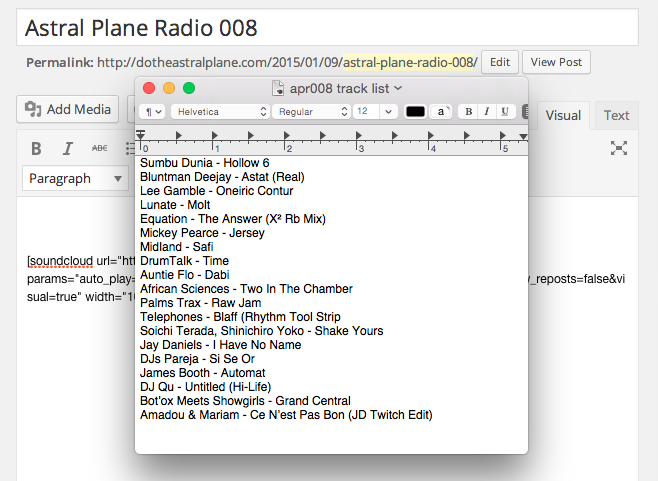
Astral Plane Radio 008
The time I spend in the office is generally filled with programming from Rinse, NTS, Berlin Community Radio Radar and other online accessible stations that consistently bring out quality shows, deejays and guests. The truth of that matter is that it’s only possible to pay attention to the show at hand for maybe two thirds of its run time due to meetings, conversations and other necessary distractions. Working in the independent music business allows for a constant stream of listening opportunities and a similarly minded audience to bounce ideas and opinions off of, but the glut often leads to passive listening. It’s inopportune and unavoidable conundrum. But it’s also why long form radio shows are so perfect for the office environment, a two hour ride that allows the listener to hop in, out and off without missing the narrative. Astral Plane Radio hasn’t really fulfilled that function to date and our more theme-oriented mixes are more pedal-to-the-floor affairs, but 008 was recorded with a long form listening experience in mind. As our tastes go, it’s percussive and full of infectious, polyrhythmic material from Auntie Flo, Afrikan Sciences and Lee Gamble. It’s also a bit slower than most of our mixes, eschewing grime and East Coast club forms for more straight forward house and techno. A bit of an adventure for the Astral Plane DJ Team, but one that befits the radio format and might just be optimal for office play. Enjoy.